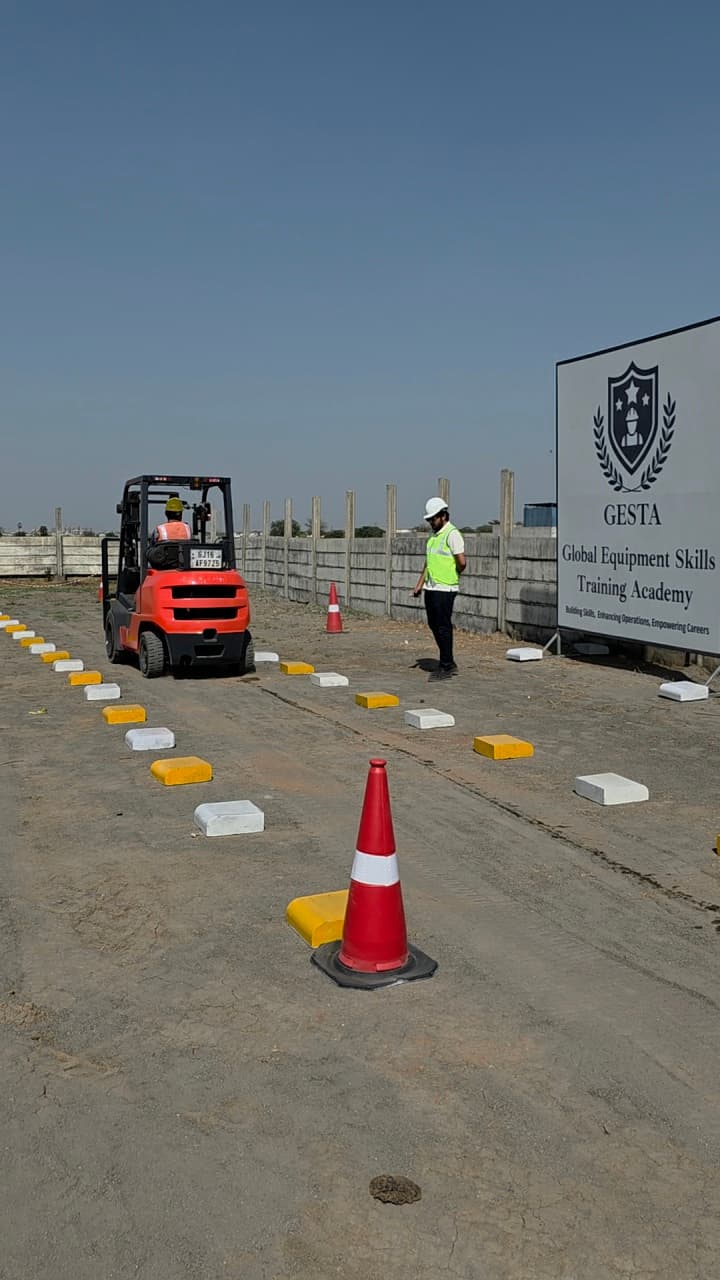
Reach Truck Operator Training
Specialized training for reach truck operations in warehouse environments.
Standards & Worldwide Alignment
This course is assessed to GESTA-STD-001 v1.1 — GESTA's harmonised operator-competency standard benchmarked to OSHA 29 CFR 1910.178 · ISO 3691 · ANSI B56.1. A GESTA certificate demonstrates the operator competency that discharges the employer's legal duty across 46 jurisdictions worldwide.
46
Countries aligned (verified)
46
Clause-level mapped
45
Competency clauses
Course syllabus — aligned to GESTA-STD-001 v1.1
Every module maps clause-by-clause to the GESTA competency standard, harmonised from the leading national frameworks.
- 1G1
Scope & Application
Applies to all rider- and pedestrian-operated powered industrial trucks (counterbalance, reach, order-picker, pallet, rough-terrain). Excludes earth-moving and on-road haulage vehicles.
- 2G2
OPERATOR ELIGIBILITY
- G2.1Minimum age · OSHA 1910.178(l); AU/UAE
- G2.2Medical & physical fitness · ZA DMR reg 18; IN medical; L117
- G2.3Comprehension · OSHA 1910.178(l)(3)(i); PUWER reg 8
- G2.4Capacity/type legal triggers · ISH Law Art 59; WHS Reg / AS 2359; Construction Machinery Mgmt Act; NR-11 / Res. SRT 960/2015
- 3G3
TRAINER & ASSESSOR
- G3.1Trainer competency · OSHA 1910.178(l)(2)(iii); L117
- G3.2Assessor independence · OSHA 1910.178(l)(6); CSA B335
- 4G4
FORMAL (THEORY) INSTRUCTION
- G4.1Operating instructions, warnings, precautions · OSHA 1910.178(l)(3)(i)(A)/(M)
- G4.2Controls & instrumentation · OSHA 1910.178(l)(3)(i)(B)/(C)
- G4.3Engine / motor operation · OSHA 1910.178(l)(3)(i)(D)
- G4.4Steering & manoeuvring · OSHA 1910.178(l)(3)(i)(E)
- G4.5Visibility & load restrictions · OSHA 1910.178(l)(3)(i)(F)
- G4.6Forks & attachments · OSHA 1910.178(l)(3)(i)(G); ISO 5057
- G4.7Rated capacity & load charts · OSHA 1910.178(l)(3)(i)(H)
- G4.8Stability (stability triangle) · OSHA 1910.178(l)(3)(i)(I); PUWER reg 20
- G4.9Operator inspection & maintenance · OSHA 1910.178(l)(3)(i)(J); PUWER reg 6
- G4.10Refuelling / battery charging · OSHA 1910.178(l)(3)(i)(K)
- G4.11Operating limitations · OSHA 1910.178(l)(3)(i)(L)
- 5G5
Practical (hands-on) training
Trainer demonstrations plus supervised practice on the actual class of truck; min. supervised practice (e.g. CSA ≥8 hrs).
- 6G6
WORKPLACE-SPECIFIC FAMILIARISATION
- G6.1Surface & ground conditions · OSHA 1910.178(l)(3)(ii)(A)
- G6.2Load composition & stability · OSHA 1910.178(l)(3)(ii)(B)
- G6.3Stacking / unstacking · OSHA 1910.178(l)(3)(ii)(C)
- G6.4Pedestrian traffic · OSHA 1910.178(l)(3)(ii)(D)
- G6.5Narrow aisles / restricted areas · OSHA 1910.178(l)(3)(ii)(E)
- G6.6Hazardous / classified locations · OSHA 1910.178(l)(3)(ii)(F)
- G6.7Ramps & gradients · OSHA 1910.178(l)(3)(ii)(G)
- G6.8Ventilation (CO / exhaust) · OSHA 1910.178(l)(3)(ii)(H)
- 7G7
ASSESSMENT
- G7.1Theory knowledge test · OSHA 1910.178(l)(2)(ii); CSA B335
- G7.2Practical skills evaluation · OSHA 1910.178(l)(2)(ii); AU HRWL
- G7.3Workplace performance evaluation · OSHA 1910.178(l)(1)(i)
- 8G8
CERTIFICATION & RECORDS
- G8.1Written certification · OSHA 1910.178(l)(6)
- G8.2Record retention · OSHA 1910.178(l)(6); PUWER reg 8
- G8.3Scope of authorisation · OSHA 1910.178(l)(1); AU Sch 3
- 9G9
REVALIDATION
- G9.1Periodic re-evaluation · OSHA 1910.178(l)(4)(iii)
- G9.2Trigger-based refresher · OSHA 1910.178(l)(4)(ii)
- 10G10
EQUIPMENT INTEGRITY
- G10.1Pre-use inspection · PUWER reg 6; OSHA 1910.178(q)(7)
- G10.2Thorough examination · LOLER 1998 reg 9
- G10.3Planned maintenance · PUWER reg 5; OSHA 1910.178(q)
- 11G11
SAFE OPERATION
- G11.1Safe operating rules · OSHA 1910.178(m)/(n); ISO 3691-1
- G11.2Load-handling limits · OSHA 1910.178(o); L117
- G11.3Parking & shutdown · OSHA 1910.178(m)(5)
- G11.4Personal protective equipment · OSHA 1910.132; EU Directive 2009/104/EC; national OSH acts
- 12G12
GOVERNANCE
- G12.1Employer duty · OSHA 1910.178(l)(1); HSWA s2
- G12.2Road-use licensing · IN MVA 1988 s3/s39; NZ F-endorse
- G12.3Risk assessment / safe system · PUWER reg 4; EU Dir Art 3
Recognised legal frameworks by country
GESTA-STD-001 v1.1 · effective 18/7/2026 · Verified/Indicative classifications are point-in-time; verify against the current official text before formal reliance.
Syllabus & Modules
GESTA-SYL-001 · Ed. 1.0- 1
Legal framework, duties and consequences
· 1.5 hoursEnsure the operator understands the legal duties that apply to forklift operation and the consequences of non-compliance.
- Explain that only a trained, assessed and competent person may operate a forklift.
- State the employer's and the operator's respective legal duties.
- Describe how the applicable national law requires training, certification and revalidation.
- Explain the difference between the competency model and the statutory-licence model, and which applies on their site.
- 2
Forklift types, classes and major components
· 1.5 hoursEnable the operator to identify truck types/classes and their major components and understand how each affects safe use.
- Identify the main forklift types (counterbalance, reach, order-picker, pallet, rough-terrain) and OSHA/ISO classes.
- Name the major components and describe their function.
- Explain how truck type determines the hazards and the certification scope.
- 3
Controls, instrumentation and pre-start
· 1.0 hourEnsure the operator can locate, identify and correctly use every control and instrument before moving the truck.
- Locate and describe the function of all controls and instruments.
- Explain the differences between operating a forklift and driving a road vehicle.
- Carry out a correct pre-start and safe mounting/start sequence.
- 4
Pre-use inspection and operator maintenance
· 1.5 hoursEnsure the operator can carry out and record a daily pre-use inspection and identify defects that remove a truck from service.
- Perform a systematic daily pre-use inspection to a checklist.
- Identify defects that make a truck unsafe and must be reported.
- Complete and retain an inspection record and understand the withdrawal-from-use rule.
- 5
Stability and the stability triangle
· 1.5 hoursEnsure the operator understands the physics of forklift stability and how their actions cause or prevent tip-over.
- Explain the longitudinal and lateral stability triangle and the combined centre of gravity.
- Describe how load weight, load centre, mast tilt, speed and turning affect stability.
- State the actions that prevent longitudinal (forward) and lateral (side) tip-over.
- 6
Rated capacity and load charts
· 1.0 hourEnable the operator to read the data plate/load chart and confirm a load is within the truck's rated capacity.
- Read and interpret the truck data plate and load-capacity chart.
- Calculate whether a given load is within capacity at its load centre.
- Explain how attachments and lift height de-rate capacity.
- 7
Forks, attachments and their limitations
· 0.75 hourEnsure the operator understands safe selection, fitting and use of forks and attachments and their effect on the truck.
- Inspect forks and attachments and reject defective items.
- Describe correct fitting and the use limitations of common attachments.
- Explain how attachments change capacity, visibility and stability.
- 8
Safe travelling and manoeuvring
· 1.5 hoursDevelop safe travelling and manoeuvring practice in all site conditions.
- Travel at a safe speed with the load trailing/leading correctly for the gradient.
- Manoeuvre, reverse and turn safely with due regard to visibility restrictions.
- Negotiate ramps, gradients, doorways, corners and restricted spaces safely.
- 9
Load handling, stacking and unstacking
· 1.5 hoursDevelop safe load-handling, stacking and unstacking technique.
- Approach, engage, lift, transport and place a load safely and squarely.
- Stack and de-stack at height while maintaining stability and visibility.
- Reject unstable, damaged or overweight loads.
- 10
Refuelling, battery and LPG safety
· 0.75 hourEnsure safe refuelling, battery charging/changing and LPG cylinder handling.
- Refuel or charge/change the power source safely following the correct procedure.
- Identify the hazards of diesel, LPG and battery systems and the controls for each.
- 11
Workplace hazards and pedestrian safety
· 1.5 hoursEnsure the operator can recognise and control workplace hazards, with priority on protecting pedestrians.
- Identify surface, traffic, aisle and environmental hazards on their site.
- Apply pedestrian-segregation rules and give pedestrians priority.
- Operate safely in narrow aisles and other restricted places.
- 12
Hazardous and special environments
· 1.0 hourEnsure the operator can operate safely in classified, confined and poorly-ventilated environments, or knows when not to.
- Recognise hazardous (classified) locations and the truck rating required.
- Explain the carbon-monoxide/exhaust risk in closed environments and the ventilation controls.
- State when an internal-combustion truck must not be used in a closed space.
- 13
Practical operation and skills (hands-on)
· ≥ 8 hours supervisedConsolidate all knowledge into competent, supervised hands-on operation of the actual truck class.
- Perform pre-use inspection, mount, start and shut-down correctly, every time.
- Travel, manoeuvre, reverse and negotiate gradients and restricted spaces safely.
- Complete load handling, stacking and de-stacking to standard.
- Park and secure the truck correctly on leaving (forks down, neutral, brake, key out).
- 14
Assessment, certification and revalidation
· 2.0 hoursFormally assess and certify the operator and set the revalidation cycle.
- Pass the theory knowledge test at the required standard.
- Pass the practical skills evaluation and workplace performance evaluation.
- Understand the scope, validity and revalidation of their certificate.